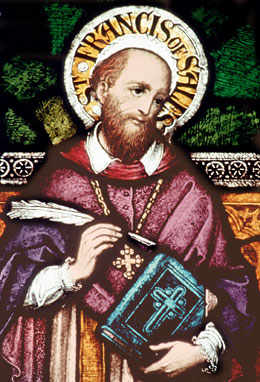
St. Francis de Sales – primary reason for the Incarnation is the communication of divine love ad extra

Below is a very enlightening passage from St. Francis de Sales’ Treatise on the Love of God where he teaches that the primary reason for the Incarnation was not the redemption of fallen man from sin, but that God willed the Incarnation first and foremost in order to “communicate Himself” to a creature in a most perfect way: “in such sort that the creature might be engrafted and implanted in the divinity, and become one single person with It”. To this created nature, namely the Sacred Humanity of Christ, God “destined that incomparable honor of personal union with His Divine Majesty, to the end that for all eternity it might enjoy by excellence the treasures of His infinite glory.”

TREATISE ON THE LOVE OF GOD Book II, Chapter IV

By St Francis de Sales

Book II. The History Of The Generation And Heavenly Birth Of Divine Love.

Ch 4. Of The Supernatural Providence Which God Uses Towards Reasonable Creatures.

All God’s works are ordained to the salvation of men and angels; and the order of his providence is this, as far as, by attention to the Holy Scriptures and the doctrine of the Fathers, we are able to discover and our weakness permits us to describe it.

God knew from all eternity that he could make an innumerable multitude of creatures with divers perfections and qualities, to whom he might communicate himself, and considering that amongst all the different communications there was none so excellent as that of uniting himself to some created nature, in such sort that the creature might be engrafted and implanted in the divinity, and become one single person with it, his infinite goodness, which of itself and by itself tends towards communication, resolved and determined to communicate himself in this manner. So that, as eternally there is an essential communication in God by which the Father communicates all his infinite and indivisible divinity to the Son in producing him and the Father and the Son together producing the Holy Ghost communicate to him also their own singular divinity; – so this sovereign sweetness was so perfectly communicated externally to a creature, that the created nature and the divinity, retaining each of them its own properties, were notwithstanding so united together that they were but one same person.

Now of all the creatures which that sovereign omnipotence could produce, he thought good to make choice of the same humanity which afterwards in effect was united to the person of God the Son; to which he destined that incomparable honour of personal union with his divine Majesty, to the end that for all eternity it might enjoy by excellence the treasures of his infinite glory.

Then having selected for this happiness the sacred humanity of our Saviour, the supreme providence decreed not to restrain his goodness to the only person of his well-beloved Son, but for his sake to pour it out upon divers other creatures, and out of the mass of that innumerable quantity of things which he could produce, he chose to create men and angels to accompany his Son, participate in his graces and glory, adore and praise him for ever. And inasmuch as he saw that he could in various manners form the humanity of this Son, while making him true man, as for example by creating him out of nothing, not only in regard of the soul but also in regard of the body; or again by forming the body of some previously existing matter as he did that of Adam and Eve, or by way of ordinary human birth, or finally by extraordinary birth from a woman without man, he determined that the work should be effected by the last way, and of all the women he might have chosen to this end he made choice of the most holy virgin Our Lady, through whom the Saviour of our souls should not only be man, but a child of the human race.

Furthermore the sacred providence determined to produce all other things as well natural as supernatural in behalf of Our Saviour, in order that angels and men might, by serving him, share in his glory; on which account, although God willed to create both angels and men with free-will, free with a true freedom to choose evil or good, still, to show that on the part of the divine goodness they were dedicated to good and to glory, he created them all in original justice, which is no other thing than a most sweet love, which disposed, turned and set them forward towards eternal felicity.

But because this supreme wisdom had determined so to temper this original love with the will of his creatures that love should not force the will but should leave it in its freedom, he foresaw that a part, yet the less part, of the angelic nature, voluntarily quitting holy love, would consequently lose glory. And because the angelic nature could only commit this sin by an express malice, without temptation or any motive which could excuse them, and on the other hand the far greater part of that same nature would remain constant in the service of their Saviour, – therefore God, who had so amply glorified his mercy in the work of the creation of angels, would also magnify his justice, and in the fury of his indignation resolved for ever to abandon that woful and accursed troop of traitors, who in the fury of their rebellion had so villanously abandoned him.

He also clearly foresaw that the first man would abuse his liberty and forsaking grace would lose glory, yet would he not treat human nature so rigorously as he determined to treat the angelic. It was human nature of which he had determined to take a blessed portion to unite it to his divinity. He saw that it was a feeble nature, a wind which goeth and returneth not, (1) that is, which is dissipated as it goes. He had regard to the surprise by which the malign and perverse Satan had taken the first man, and to the greatness of the temptation which ruined him. He saw that all the race of men was perishing by the fault of one only, so that for these reasons he beheld our nature with the eye of pity and resolved to admit it to his mercy.

But in order that the sweetness of his mercy might be adorned with the beauty of his justice, he determined to save man by way of a rigorous redemption. And as this could not properly be done but by his Son, he settled that he should redeem man not only by one of his amorous actions, which would have been perfectly sufficient to ransom a million million of worlds: but also by all the innumerable amorous actions and dolorous passions which he would perform or suffer till death, and the death of the cross, to which he destined him.

He willed that thus he should make himself the companion of our miseries to make us afterwards companions of his glory, showing thereby the riches of his goodness, by this copious, abundant, superabundant, magnificent and excessive redemption, which has gained for us, and as it were reconquered for us, all the means necessary to attain glory, so that no man can ever complain as though the divine mercy were wanting to any one.

St. Francis de Sales, pray for us!
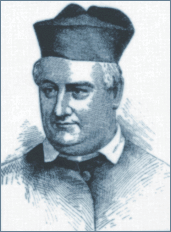
Fr. Frederick Faber on the absolute primacy of Christ

Fr. Frederick Faber (1814-1863): convert to Catholicism from the Anglican ecclesial community, poet and songwriter (ie. Faith of our Fathers), author of many profound volumes both devotional and doctrinal on the Catholic Faith. Fr. Faber held the Franciscan position of Bl. John Duns Scotus on the Incarnation, namely that Christ has absolute primacy in God’s plan quite apart from any consideration of sin and, with and subordinate to Christ, Mary was predestined to be the Mother of God (Theotokos) with a subordinate primacy above all men and angels. The following is a snippet from a conference given by Msgr. Arthur B. Calkins where he shows the eloquent expressions of Fr. Faber illustrating the absolute primacy of Christ Jesus:

[…]It should be noted that, while Faber did not hesitate to employ the hypothetical mode of defending the Scotist position, his aim always went beyond such a limited formulation. What he underscored was that “Jesus was decreed before all creatures, and therefore before the permission of sin”.

Faber clearly saw the implications of the Scotist thesis in establishing the predestination and primacy of Christ. Here is how he put the matter in his last work and masterpiece, Bethlehem:

What then was the first aspect of creation in the divine mind, if we may use the word “first”, of that which was eternal? There may at least be a priority of order, even though there be no priority of time. There is precedence in decrees, even where there is not succession. The first aspect of creation, as it lay in the mind of God, was a created nature assumed to his own uncreated nature in a Divine Person. In other words, the first sight in creation was the Babe of Bethlehem. The first step outside of God, the first standing-point in creation, is the created nature assumed to a Divine Person. Through this, as it were, lay the passage from the Creator to creatures. This was the point of union, the junction between the finite and the Infinite, the creature blending unconfusedly with the Creator. This first-born creature, this Sacred Humanity, was not only the primal creature, but it was also the cause of all other creatures whatsoever. … Its predestination is the fountain of all other predestinations. The whole meaning of creation, equally with the destinies of each individual creature, is bound up with this created Nature assumed to a Divine Person. [40]

Consistent expositor of the Scotistic thesis that Faber was, he recognized that it provides a marvellous key for entering into the mystery that “all things were created through him and for him. He is before all things, and in him all things hold together” (Col. 1:16-17). “This means”, as Juniper Carol put it, “that in the divine mind from all eternity the creation of the universe and everything in it was based on Christ, had Christ as its foundation, fulcrum and support.” [41] Faber also rightly dwelt on the biblical datum that the Father “chose us in him before the foundation of the world, that we should be holy and blameless before him. He predestined us in love to be his sons through Jesus Christ” (Eph. 1:4-5). Thus the predestination of the elect is conditioned on Christ, and not the other way around. It presupposes the existence of Christ present to the mind of God in His eternal plans. [42]

In no human creature is predestination in Christ illustrated to greater perfection than in Mary. In willing the Incarnation, God willed Mary. Here is how Faber put it in Bethlehem:

Mary thus lies high up in the very fountain-head of creation. She was the choice of God himself, and he chose her to be his Mother. She was the gate by which the Creator entered into his own creation. She ministered to him in a way and for an end unlike those of any other creature whatsoever. … When we have said that Mary was the Word’s eternal choice, we have said that which already involves all the doctrine of the Church about her, and all the homage of Christians to her. … What more can be said? She fulfilled his idea, or rather she did not so much suit his idea, but she was herself the idea, and his idea of her was the cause of her creation. The whole theology of Mary lies in this eternal and efficacious choice of her in the Bosom of the Father. [43]

It is precisely on this basis that Faber speaks constantly in all of his books about “the predestination of Jesus and Mary” and “the mysteries of Jesus and Mary”. Even though Jesus is God and Mary is only a human creature, in willing the Incarnation, God also willed and predestined Mary.

It was, in fact, only in Faber’s lifetime that the supreme authority of the Church solemnly ratified this foundational datum of what has come to be called the “Franciscan thesis” on the joint predestination of Jesus and Mary. The roots of this thesis, as Father Peter Damian Fehlner tells us

antedate both Scotus and Francis himself. It is franciscan, not by reason of origin (in this it is rather Catholic), but by reason of its promotion, of its being rendered more explicit and then more effectively incorporated into the life of the Church, as St. Maximilian Kolbe would say. [44]

The specific intervention on the part of the magisterium was the statement to be found in Ineffabilis Deus, Pius IX’s Bull defining the dogma of the Immaculate Conception: “God, by one and the same decree, had established the origin of Mary and the Incarnation of Divine Wisdom.” [45] On the basis of this principle, subsequently re-confirmed by the papal magisterium, [46] Mary’s intimate association with Jesus in the work of the redemption is also axiomatic and, thus, Pius IX declared in the same Apostolic Constitution:

Hence, just as Christ, the Mediator between God and man, assumed human nature, blotted the handwriting of the decree that stood against us, and fastened it triumphantly to the cross, so the most holy Virgin, united with Him by a most intimate and indissoluble bond [uno eodemque decreto], was, with Him and through Him, eternally at enmity with the evil serpent, and most completely triumphed over him, and thus crushed his head with her immaculate foot. [47]

Mary at the Foot of the Cross: Acts of the International Symposium on Marian Coredemption ^ | March 7, 2002 | Msgr. Arthur B. Calkins
 
 
Another quote of Fr. Faber on the subject can be found in his book The Blessed Sacrament, written in 1854:

The third view of the Incarnation, and the one assumed throughout this treatise to be true, is the view taken by the Scotists, and by Suarez, and many other theologians both ancient and modern. It teaches, that our Lord came principally to save fallen man, that for this end He came in passible flesh; but that even if Adam had not fallen He would have come, and by Mary, in impassible flesh, that He was predestinated the first-born of creatures before the decree which permitted sin, that the Incarnation was from the first an intentional part of the immense mercy of creation, and did not merely take occasion from sin, which only caused Him to come in a particular way in which He came, and was not the cause of His coming altogether. …

Those who hold it (this view) dwell very much on the doctrine that Jesus was decreed before all creatures, and therefore before the permission of sin. Thus we read in Scripture, I came out of the mouth of the Most High, the first-born before all creatures. And St. Paul, speaking of our Lord, says to the Colossians, that He is the image of the invisible God, the first-born of every creature. For in Him were all things created in heaven, and on earth, visible and invisible, whether thrones, or dominations, or principalities, or powers. All things were created by Him and in Him, and He is before all, and by Him all things consist. And He is the Head of the Body, the Church, who is the beginning, the first-born from the dead, that in all things He may hold the primacy…

From these and a host of similar authorities, the Scotists, with Suarez and others, particularly Franciscans and Jesuits, consider that it follows that all men came because of Christ, not Christ because of them, that all creation was for Him, and was not only decreed subsequently to His predestination, but for His sole sake. …

Both the Thomist and Scotist views of the Incarnation are free opinions in the schools; and I have only dwelt more at length on the last because it is the one I have all along assumed to be true, and because I think Suarez does not succeed in making a harmony of the two: and as I have mainly followed St. Thomas in the other questions which have been touched upon in this book, it seemed necessary to confess to this somewhat notable exception.

 
From The Blessed Sacrament (Philadelphia: The Peter Reilly Co., 1958) 336-337, 339

lapidem angularem: Christ the cornerstone

While I have already treated this subject in the section Christ, the Cornerstone, I recently came across a very interesting passage in the book of Job. After all that Job had been through and all his “friends” put him through, God then humiliates him to the dust – that is, before lifting him back up and blessing even more than before. In showing Job that he is, well, basically nothing, God asks Job if he knows anything, really, at all about the Creator and His handiwork. In that discourse God asks him:

Where wast thou when I laid up the foundations of the earth? tell me if thou hast understanding. Who hath laid the measures thereof, if thou knowest? or who hath stretched the line upon it? Upon what are its bases grounded? or who laid the corner stone thereof, When the morning stars praised me together, and all the sons of God made a joyful melody?
(Job 38:4-7)

 
While, on a superficial level, one can write this off as just saying, “Where were you, you ignorant nothing, when I did My work of creation?”, nonetheless, it is unique in that here God notes that there was praise and joyful melody regarding “the corner stone”.

I can’t go into it here (I hope to later), but there is an entire deposit of Wisdom literature where created Wisdom is spoken of as being present before God when He created the universe (see, for example, Prov 8:22-9:6). We know that the Word is uncreated Wisdom, but Scripture reveals to us that when God created the universe He had before Him that created Wisdom. This is a clear reference to the Humanity (created) of Christ, that is, to the Incarnate Word. Jesus is one Divine Person (Wisdom) with two natures: divine (uncreated, eternal) and human (created, temporal). In creating the universe God first willed Christ, the Word Incarnate, the cornerstone – lapidem angularem (Job 38:6), He willed to build all upon Him as the supreme cornerstone – summo angulari lapide Christo Iesu (Eph 2:20). All creation is with Christ in mind (He is the center of all creation – Col 1:15-20).

For convenience, here is the link of a pertinent video on Christ the Cornerstone:


Blessings in Christ the cornerstone!
fr maximilian mary dean, F.I.

Beatification of Scotist: Fr. Gabriel M. Allegra, OFM

An extraordinary grace for the Church: Fr. Gabriele Maria Allegra, OFM, (Dec. 26, 1907–Jan. 26, 1976) will be beatified on September 29, 2012. He translated the entire Bible into Chinese and is popularly known as the “St. Jerome of China.” As a Franciscan, missionary and biblical scholar, he saw the doctrine of the absolute primacy of Christ as being central to understanding Sacred Scripture and God’s design in creating and redeeming the universe. He was renowned for his knowledge of the theology and philosophy of Bl. John Duns Scotus and was even invited by Oxford Universtiy to give the 700th centenary lecture on the latter. He also wrote a beautiful treatise on the Immaculate Heart of Mary and the spiritual life which has been out of print for some time now and which I cite on this website in the section on the mediation of Jesus and Mary.

For your convenience and edification, here is the passage cited with the footnote:


“Since God the Father has chosen us in Christ before the creation of the world, it is simply logical that the first willed, the first loved, the first elected one of the Father is Jesus Christ. Now since Jesus Christ, the Incarnate Word and Lord of the universe and particularly of humanity, is Himself a man and, therefore, our Brother, He had to have a Mother. And, as Pope Pius IX appropriately said, by the same eternal decree in which God willed the Incarnation of His Only-begotten Son, He also willed specifically His Son’s Immaculate Mother…

“What God has determined from all eternity before the creation of the world is fulfilled in time. And what is fulfilled is nothing else than the carrying out of God’s decree from the beginning, before He created the angelic spirits, the earth, and mankind. The action of God, like His Word, is an infallible and creative action.

“In reference to the Immaculate Mother of the Incarnate Word, the Holy Trinity performed this miracle of miracles 2000 years ago. But this work, the creation of Mary, which together with the Incarnation of His Word is the first and ‘greatest work of God’ (Bl. John Duns Scotus) and coterminous with God’s life, is hidden in the eternity of His eternal design.”

Fr. Gabriel Allegra, OFM, Mary’s Immaculate Heart: A Way to God (Franciscan Herald Press, Chicago, 1982) 19-20.

By way of anticipation…

“Blessed” Gabriel Mary Allegra, pray for us!

fr. maximilian mary dean, F.I.

Fr. Johannes Schneider, OFM: the primacy of Christ in St. Francis of Assisi; Bl. John Duns Scotus the perfection of his thought

In the second presentation (just shy of 40 minutes long) at our International Centenary Symposium on the Mariology of Bl. John Duns Scotus held in Durham, England, Fr. Johannes Schneider, OFM, discusses the Christocentrism and “prescotistic” thought of St. Francis of Assisi, demonstrating in a definitive way that Bl. John Duns Scotus was a true son of the Seraphic Father. Fr. Johannes’ presentation is read by Fr. Peter D. Felhner, F.I. There is some Latin, but always accompanied by English translations and explanations, so “fear not!”

The writings of Bl. John Duns Scotus are “the beautiful form of the perfection of St Francis of Assisi and the fervour of his seraphic spirit are certainly hidden and yet present [therein].”
Pope Paul VI, Alma Parens, 1966.

Seraphic Father St. Francis, pray for us!

Bl. John Duns Scotus, pray for us!

fr. maximilian mary dean, F.I.


P.S. I highly recommend Fr. Johannes Schneider’s study on the presence of Mary in the Crucifix of San Damiano and in the Office of the Passion of St. Francis of Assisi. The book is entitled Virgo Ecclesia Facta – The Virgin made Church. Perhaps the best study of the San Damiano Crucifix and of the Marian spirituality of St. Francis of Assisi available in the English language today.

Fr. Gabriel Amorth, Exorcist: Christ is the center of all creation, yes, even if Adam had not sinned

While the following has already been cited on this website (under the section on the Colossians where Christ’s headship and primacy is discussed), I thought it worth posting here, separately, after the post on Christ as the center of the angelic world as the Catechism of the Catholic Church # 331. Here is the citation directly from my book, A Primer on the Absolute Primacy of Christ:

In recent times, an expert on angelology and demonology, the chief exorcist of the Diocese of Rome, Fr. Gabriel Amorth, wrote a most concise and lucid summation of the Franciscan thesis in his book An Exorcist Tells his Story. Before he ‘tells his story’, he begins by “first stating some basic facts about God’s plan for creation.” He writes:

“All too often we have the wrong concept of creation, and we take for granted the following wrong sequence of events. We believe that one day God created the angels; that He put them to the test, although we are not sure which test; and that as a result we have the division among angels and demons. The angels were rewarded with heaven, and the demons were punished with hell. Then we believe that on another day God created the universe, the minerals, the plants, the animals, and, in the end, man. In the Garden of Eden, Adam and Eve obeyed Satan and disobeyed God; thus they sinned. At this point, to save mankind, God decided to send His Son.

“This is not what the Bible teaches us, and it is not the teaching of the Fathers. If this were so, the angels and creation would remain strangers to the mystery of Christ. If we read the Prologue of the Gospel of John and the two Christological hymns that open the letters to the Ephesians and the Colossians, we see that Christ is ‘the firstborn of all creatures’ (Col. 1:15). Everything was created for Him and in the expectation of Him. There is no theological discussion that makes any sense if it asks whether Christ would have been born without the sin of Adam. Christ is the center of creation; all creatures, both heavenly (the angels) and earthly (man) find in Him their summation. On the other hand, we can affirm that, given the sin of our forebears, Christ’s coming assumed a particular role: He came as Savior. The core of His action is contained within the Paschal Mystery: through the blood of His Cross, He reconciles all things in the heavens (angels) and on earth (man) to God. The role of every creature is dependent on this christocentric understanding.”

Fr. Gabriel Amorth, An Exorcist Tells his Story (Ignatius Press, San Francisco, 1999) 19-20.

Msgr. Arthur Calkins comments on this passage and adds another quote of Amorth on how important this doctrine of the absolute primacy of Christ is for understanding Our Lady.

fr. maximilian mary dean, F.I.

Catechism: Christ is the center of the angelic world

The Catechism of the Catholic Church #331 explicitly states: 

Christ is the centre of the angelic world. They are his angels: “When the Son of man comes in his glory, and all the angels with him.” (Mt 25:31) They belong to him because they were created through and for him: “for in him all things were created in heaven and on earth, visible and invisible, whether thrones or dominions or principalities or authorities – all things were created through him and for him.” (Col 1:16) They belong to him still more because he has made them messengers of his saving plan: “Are they not all ministering spirits sent forth to serve, for the sake of those who are to obtain salvation?” (Heb 1:14)

Some would have us believe that there were two economies of grace: one economy before the fall of Adam and Eve which would include Adam and Eve before original sin and all of the Angels – the gratia Dei, and a second economy in Christ after the fall – the gratia Christi, which would be limited to Adam and his progeny. But if Jesus is the center of the angelic world, this clearly indicates that there is only one economy of divine grace, the gratia Christi: “No one comes to the Father except through Me” (Jn 14:6). The good Angels were created under Christ’s headship and Christ was, in the design of God, the firstborn of all creatures. The good Angels are centered on Him, not because of Adam’s sin and his need for Redemption, but simply because they were created through and for Christ, as St. Paul points out in his letter to the Colossians.

fr. maximilian mary dean, F.I.

Bl. John Duns Scotus – Primacy of Christ: a REVEALED truth

P L E A S E take 20 minutes to watch the section of this conference of my confrere, Fr. Agnellus M. Murphy, to the “Our Lady of Walsingham Ordinariate” where, to explain Our Lady’s place in God’s plan, he synthesizes the primacy of Christ. The pertinent part of the video with regards to the doctrine of the absolute primacy of Christ according to Bl. John Duns Scotus and the Apostle St. Paul starts at 6:20 and continues to 28:00, although I would recommend watching the whole 3 hour series – it is well done and very informative.


fr. maximilian mary dean, F.I.

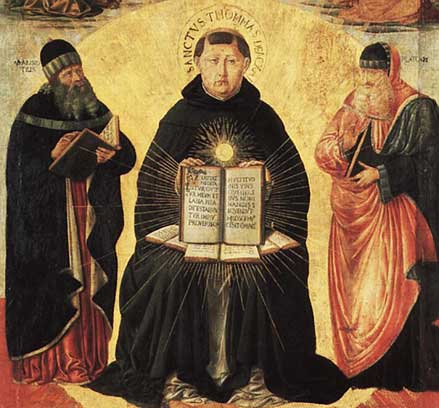
St. Thomas Aquinas: unconditional Incarnation “possible” and “probable”

With all of my previous posts, one might have the false impression that I am “anti-Thomas.” Nothing could be farther from the truth. St. Thomas Aquinas is the champion of the stupendous doctrine on the Real Presence of Our Lord in the Holy Eucharist – “transubstantiation” – which is central to my life and spirituality (and that of any true Franciscan, or Catholic, for that matter); after all, he wrote the Mass and Office for Corpus Domini. The icing on the cake, at least for me, is that he speaks of the dignity of the Mother of God as a “quasi-infinite”: “The humanity of Christ, from the fact that it is united to the Godhead; and created happiness from the fact that it is the fruition of God; and the Blessed Virgin from the fact that she is the mother of God; have all a certain infinite dignity from the infinite good, which is God. And on this account there cannot be anything better than these; just as there cannot be anything better than God. “ (Summa I, Q 25, art.6 – 4th reply). God could not have created a more beautiful and glorious Mother, and to think that she is my Mother in the order of grace…

Viva St. Thomas!

While I may disagree with him when he says that it is “more probable” that the Incarnation of the Word was willed by God primarily (or even exclusively) as a remedy to sin, that does not mean I am against him. St. Thomas Aquinas has fought the good fight, taken his crown, and is a canonized Saint and Doctor of the Church; I, on the other hand, need his prayers, example and teachings to help me work out my salvation with fear and trembling (cf. Phil 2:12). So…

St. Thomas Aquinas, pray for me, that I too may be made worthy of the promises of Christ!

That said, and having commented from a scotistic point of view on his teaching regarding the primary motive for the Incarnation, I would like to underscore that he never excludes the possibility of the contrary position that Christ’s coming in the flesh could have been God’s will even if Adam had not sinned. The teaching of the Angelic Doctor is that there are two opinions:

There are different opinions about this question. For some say that even if man had not sinned, the Son of Man would have become incarnate. Others assert the contrary… (Summa Theologica III, I, 3)

So the latter, for him, was “more probable,” yet he concludes his presentation with, “Even had sin not existed, God could have become incarnate” (ibid). In his commentary on the Sentences he states regarding an unconditional Incarnation that this “opinion can also be called probable” (In Sent. III, d.1, q.1, a.3). That said, St. Thomas does not rule out what will come to be known as the Franciscan thesis which was especially developed and championed by Bl. John Duns Scotus. Rather, he sees it as “possible” and even “probable,” while embracing the view that he deems “more probable.”

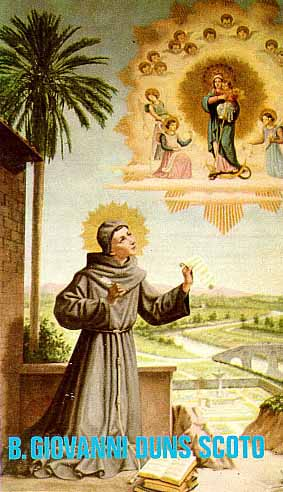
Bl. John Duns Scotus, on the other hand, is very articulate and definitive on the subject. Unlike Thomas who sees both views as opinions worthy of consideration and doesn’t give much weight to the argument (i.e. Aquinas writes, “this is not a very important question” In 1 Tim., c.1, lect.4), the Subtle Doctor does not consider the position of “no sin, no Incarnation” as possible or probable because, according to logic and the Scriptures, this was not God’s plan and is not how God operates. And, obviously, for him the question was central.

The scotistic doctrine on the absolute primacy of Christ constitutes, to use Dr. Mark Miravalle’s comment, “a Copernican revolution” in Theology (and consequently Mariology) because it places Christ the Sun of Justice and His Immaculate Mother clothed with the sun at the center of God’s plan, as opposed to placing Adam and Eve and the earthly paradise at the center and attempting to “measure” Christ and Mary according to man’s need for redemption from sin. I think it is clear enough that a christocentric Theology, Christology, Mariology, Angelology and spirituality have different accents and rhythms than that which results from a Theology where Christology is centered on sin – even if both positions uphold all of the essential dogmas of the Faith. The difference is huge, just as in our solar system there is huge difference between saying the sun is at the center or the earth, even if everything can be calculated (with great difficulty) by saying that the earth is at the center, when everyone was crying out, “Earth centered!”, the idea of a solar system was revolutionary.

Since I have already extensively treated Scotus’ positions throughout this website, I will not repeat that work in the posts, but I do hope to highlight some of his principle arguments and then frequently quote and refer to his thoughts throughout future posts and discussion. An Overview of his doctrine of the absolute primacy of Christ and his specific Writings on the subject are available at the links.

fr. maximilian mary dean, F.I.

Dumb ox or dunce – Part II E

Aquinas’ fifth [and perhaps most interesting] argument in favor of Scotus’ position, and his response to the contrary:

Objection 5. Further, the mystery of Incarnation was revealed to the first man, as is plain from Genesis 2:23. “This now is bone of my bones,” etc. which the Apostle says is “a great sacrament . . . in Christ and in the Church,” as is plain from Ephesians 5:32. But man could not be fore-conscious of his fall, for the same reason that the angels could not, as Augustine proves (Gen. ad lit. xi, 18). Therefore, even if man had not sinned, God would have become incarnate.

His response:

Reply to Objection 5. Nothing prevents an effect from being revealed to one to whom the cause is not revealed. Hence, the mystery of Incarnation could be revealed to the first man without his being fore-conscious of his fall. For not everyone who knows the effect knows the cause.

Adam knew about the Incarnation before the fall

First, let us establish the tradition before looking at his response. St. Thomas Aquinas, in defending his position that had Adam not sinned the Incarnation would not have taken place, finds it necessary to acknowledge and defend himself against a tradition that confirms that before the fall God had revealed to Adam the mystery of the Incarnation. Obviously, if Adam knew about the Incarnation before the fall, this presents a slight difficulty to the thomistic position that the Incarnation was completely occasioned by Adam’s sin.

Note well that the Angelic Doctor does not ignore the tradition (he is the one who presents it as an objection to his thesis), nor does he write it off as a bunch of malarchy (he deals with it concretely elsewhere in his Summa, as we shall see below). He takes this tradition very seriously and feels the necessity to dance around it with distinctions to maintain his position without denying the tradition itself. His insistence on acknowledging and maintaining this tradition is extremely interesting because today it is either unknown, ignored or written off as unsubstantial. For him it appeared to be part of the deposit of the Faith, an undeniable truth which he mentions at least twice in his Summa. So, is Adam’s foreknowledge of the Christ a piece of Sacred Tradition lost in the shuffle? Well, not if I can have anything to do with it. 🙂

The Church Fathers

This tradition of Adam’s foreknowledge of the Incarnation before he fell into original sin is found in the Church Fathers, and specifically in St. Jerome and Tertullian.

St. Jerome: The first prophet Adam prophesied this about Christ and the Church: that Our Lord and Savior would have left His God and His mother, the heavenly Jerusalem; that He would come to earth for the sake of His Body, the Church; that the Church would have been taken from His side and for her the Word would have been made flesh. (Commentary on Eph. 5:31-32)

Tertullian mentions it in passing here: What had he [Adam] that was spiritual? Is it because he prophetically declared the great mystery of Christ and the church? Ephesians 5:32 This is bone of my bone, and flesh of my flesh: she shall be called Woman. Therefore shall a man leave his father and mother, and he shall cleave unto his wife; and they two shall be one flesh. Genesis 2:23-24 But this (gift of prophecy) only came on him afterwards, when God infused into him the ecstasy, or spiritual quality, in which prophecy consists. (Treatise on the soul, Ch.21)

 The contents: mystic sleep of Adam, revelation of Christ, prophecy of Adam

Let’s look at the two specific texts of Aquinas confirming the tradition in order to understand what the scholastics had received from the Church Fathers regarding Adam and his foreknowledge of the Incarnation.

1. St. Thomas writes that man does, however, seem to have had foreknowledge of the Incarnation of Christ, from the fact that he said (Genesis 2:24): “Wherefore a man shall leave father and mother, and shall cleave to his wife,” of which the Apostle says (Ephesians 5:32) that “this is a great sacrament . . . in Christ and the Church,” and it is incredible [literally “not-believable”] that the first man was ignorant about this sacrament.
( Summa II-II, Q.2, art.7 – “I answer that..”).

2. As cited above, he acknowledges this tradition as one which could pose a problem to his thesis on a Incarnation caused by sin, and he describes it thus: the mystery of Incarnation was revealed to the first man, as is plain from Genesis 2:23. “This now is bone of my bones,” etc. which the Apostle says is “a great sacrament . . . in Christ and in the Church,” as is plain from Ephesians 5:32.
(Summa III, Q.1, art.3 – Objection 5)

What we have here is a Patristic interpretation, and perhaps an Apostolic Tradition, about Eph 5:32 and Gen 2:23-24. In essence St. Paul provides the hermeneutic or interpretive key to understanding Gen 2:21-24. First, Genesis:

Then the Lord God cast a deep sleep upon Adam: and when he was fast asleep, He took one of his ribs, and filled up flesh for it. And the Lord God built the rib which He took from Adam into a woman: and brought her to Adam. And Adam said: This now is bone of my bones, and flesh of my flesh; she shall be called woman, because she was taken out of man. Wherefore a man shall leave father and mother, and shall cleave to his wife: and they shall be two in one flesh. Gen 2:21-24

And the interpretive key:

“For this cause a man shall leave his father and mother, and cleave to his wife; and the two shall become one flesh.” This is a great mystery – I mean in reference to Christ and to the Church. Eph 5:31-32

The tradition is specifically this, that when Adam was put into that deep, mystic sleep, the Lord YHWH revealed to him the mystery of Christ and the Church and for this reason a man and woman espouse and form one flesh. In this context, when Adam awoke from that mystic sleep and was presented Eve, he had been shown the great mystery of Christ, the Divine Bridegroom who would be his descendant, and the Church, the Bride, who would be taken from the side of Christ, and he exclaimed prophetically: 1) of Christ that He would leave His heavenly Father and His mother, the heavenly Jerusalem, to become one with His Bride the Church, and 2) of the Church taken from the side of Christ, This now is bone of my bones, and flesh of my flesh; she shall be called woman, because she was taken out of man. Adam saw in himself a prefigurement of the New Adam – as St. Paul points out, Adam, a figure of him who was to come (Rm 5:14) – and was stunned at the beauty and grace of Eve, a prefigurement of the Bride of Christ, the Church, the true Mother of all the living (Gn 3:20), taken from His side.

As a brief corollary which, God willing, I will be permitted to develop later, the whole “theology of the body” of Bl. John Paul II seems to be an implicit confirmation of the absolute primacy of Christ because in the beginning – before the fall – man and woman, husband and wife, reflected in their relationship this mystery of life and union between Christ and the Church. In other words, if St. Thomas Aquinas were alive today and acknowledged John Paul II’s theology of the body, he would have to add a sixth objection to his position and make some more fancy distinctions to accept the ordinary magisterium of Pope John Paul II’s theology of the body and maintain that indeed Adam and Eve reflected the great mystery of Christ and His Church before the fall, all the while asserting that had Adam not sinned, none of this was to be.

Aquinas’ response and the crazy logic (IMHO) that flows from it

Let’s assume, for the sake of argument, that this tradition is authentic (after all, St. Thomas did!). This means that Adam knew about the Incarnation of the Word before the fall. St. Thomas here is on the defensive because logically it would seem odd, if not outright impossible, that God would have revealed the Incarnation of the Word to Adam before he had sinned if Christ’s coming was solely to be a remedy of Adam’s transgression. The Angelical Doctor ignores the fact that this would be illogical and only responds that, as crazy as it may be, it was nonetheless possible that God could have willed the Incarnation as a remedy for sin and yet shown Adam the truth of the Incarnation before the fall:

Nothing prevents an effect from being revealed to one to whom the cause is not revealed. Hence, the mystery of Incarnation could be revealed to the first man without his being fore-conscious of his fall. For not everyone who knows the effect knows the cause.

I think we can all agree with Thomas that this is possible, namely, that God could reveal an effect without showing its cause. So, yes, the mystery of the Incarnation could be revealed to the first man without his being fore-conscious of his fall. But is it likely? If Christ is to come solely to remedy sin, then there would be not reason for God to reveal this to Adam before the fall. So it remains odd, to say the least.

The tradition: Adam knew about the Christ, the God-Man; he knew and was ecstatic about the union of Christ the Lord with His people, the Church; he knew that he and Eve were to marvellously reflect that great mystery of the union of Christ and the Church.

And yet, if we follow St. Thomas on the cause of the Incarnation, all of these beautiful things revealed to Adam before the fall were to be occasioned by sin!?! Let’s spell this out: According to the thomistic position, if Adam had not sinned, Christ, the God-Man would never have come; but God chose to reveal His coming to him without showing the cause? If there were no original sin, God would not have established the Church and espoused her (that’s us) to Himself in Christ Jesus; but He chose to reveal to Adam this great mystery of the mystical espousals of Christ and the Church without showing that this great mystery and intimacy presupposed Adam’s unfaithfulness and transgression? Since, according to this position, Christ and His Bride the Church are occasioned by and the remedy to Adam’s sin, this means that Adam and Eve gloriously prefigured the fruitful union of Christ and His Church because of sin; or expressed another way, without the disobedience of Adam’s sin, Adam and Eve would not have prefigured Christ and the Church. So, in the thomistic scheme of things, God starts with a plan A – an economy of grace without Christ, the gratia Dei – and before plan A is ruptured, He already reveals to Adam a better, more beautiful and glorious plan B which will be caused by Adam and Eve’s disobedience but which would not be realized if Adam obeyed God’s original plan, so that while they are still in the gratia Dei of plan A, God reveals to them the gratia Christi of plan B.

Folks, are you with me? Can you not see that if Adam foreknew of Christ before the fall this would clearly indicate (and perhaps even prove) that God created Adam and Eve with a view to Christ? That there was only one plan (no afterthoughts) with one economy of grace, namely the gratia Christi? In other words, when God created the world He had one plan, one mystery, one purpose, Jesus Christ. He willed Christ and the Church, then He began creating. Adam and Eve were created to reflect His glorious plan by their union and fruitfulness and He revealed this to them. Sin did not change this plan in its substance, but necessitated punishment and reconciliation. And actually, from this point of view, we can say that Adam and Eve (and the fallen angels) went against God’s plan to recapitulate all things in Christ.

As such, the Redemption from sin is caused by sin, but the Incarnation is not. Actually, the Redemption necessarily presupposes the Incarnation of the Word; whereas the Incarnation of the Word does not necessarily presuppose the Redemption. For Scotus and the Franciscan thesis, this tradition of Adam’s foreknowledge of the Incarnation fits in nicely with the doctrine of the unconditional, absolute predestination of Christ to grace and glory without any consideration of sin. In the scotistic framework, Adam and Eve were to reflect that great mystery of the union of Christ and the Church because, sin or no sin, they were created to prefigure Christ and His Bride. Actually, had they not sinned they would have reflected this great mystery even better.

Let me conclude this post with a little story I read in the National Catholic Register at the time of the beatification of St. Teresa Benedicta of the Cross, OCD (aka Edith Stein) back in 1998. After translating several volumes of St. Thomas Aquinas into German, one of the nuns of her community in recreation asked St. Teresa Benedicta what she thought of St. Thomas’ writings. She responded more or less like this, “I agree with him in everything; but when it comes to the Incarnation, I follow Scotus.”

Amen. Viva Bl. John Duns Scotus!

Fr. Maximilian M. Dean