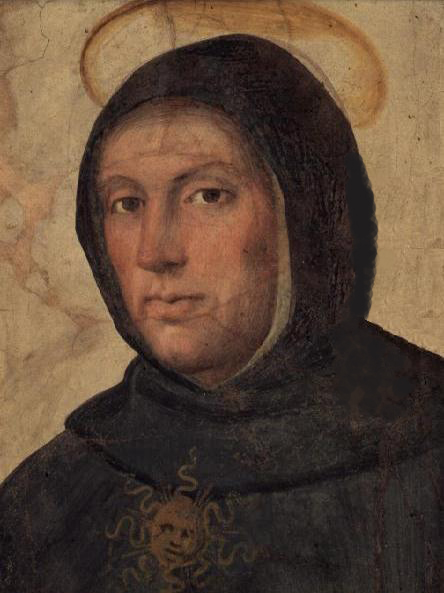
St. Bernard of Clairvaux – Christ redeemed the good Angels
It is fascinating that in speaking of Christ as Savior – soteriology – St. Bernard, while he does not come to the same conclusion as Bl. John Duns Scotus on the absolute primacy of Christ and on the Immaculate Conception of Our Lady, nonetheless argues for a preservative redemption of the Holy Angels. This thought is almost unheard of, and yet if he is correct and Christ indeed redeemed the Angels by preserving them from falling, this would indicate that the Incarnation was not simply willed as a remedy for man’s sin, but that Christ would have come as Mediator of grace and glory to men and Angels quite regardless of Adam’s sin. Also, a preservative redemption of the good Angels would be coherent with the preservative redemption of Our Lady, thus an implicit confirmation of Scotus’ doctrine (now dogma of the Church) on the Immaculate Conception of Our Blessed Mother.
Here is the text of the Mellifluous Doctor:
“You say, ‘I don’t see how it could be possible that there was a redemption for the Angels. The authority of the Scriptures, in fact, does not seem to uphold anywhere that they were imprisoned by sin or subject to death so as to need redemption – except, perhaps, those who were carried away by the irreparable sin of pride and do not merit to be redeemed. If, therefore, the Angels were never redeemed – the good because they had no need of it, the bad because the do not deserve it; the former because they did not fall, the latter because they are not capable of forgiveness – in what sense do you maintain that Christ the Lord was redemption for them?’ Listen for a minute. He who lifted fallen man up again assigned him to an Angel who is at his side so that he may not fall, thus freeing man from slavery and preserving the angel from entering into it. In this sense He was redemption equally for both of them, freeing the former and preserving the latter. It is clear, therefore, that Christ the Lord was, for the Angels, redemption, justification, wisdom and sanctification”. (Sermon on the Song of songs, XXII, 6).
For a deeper understanding of salvation from this perspective of the primacy of Christ see the section on Christ as Redeemer and Christ came for our salvation by scrolling down under Eph 1:3-10.
Aquinas’ fourth argument in favor of Scotus’ position, and his response to the contrary:
Objection 4. Further, God’s predestination is eternal. But it is said of Christ (Romans 1:4): “Who was predestined the Son of God in power.” Therefore, even before sin, it was necessary that the Son of God should become incarnate, in order to fulfil God’s predestination.
His response:
Reply to Objection 4. Predestination presupposes the foreknowledge of future things; and hence, as God predestines the salvation of anyone to be brought about by the prayers of others, so also He predestined the work of Incarnation to be the remedy of human sin.
While we could argue with the Angelic Doctor that it is possible that God predestined Christ to be “the Son of God in power” solely on account of man’s sin, that certainly is not an argument in favor of Aquinas’ position. At best this possibility only shows that there are two principal opinions regarding the Incarnation: either Christ was predestined first and prior to any consideration of sin (and thus Mary, the Angels and the Saints were predestined in Christ “before the foundation of the world” regardless of sin cfr. Eph 1:4); or sin was foreseen first and prior to any consideration of Christ’s predestination (and consequently the predestination of Mary and the Saints in Christ was based on a foreknowledge of sin).
Yes, both Aquinas and Scotus know that God is outside of time; but to speak intelligently about a well ordered plan (namely, God’s plan in creation), one has to speak of a priority. They differ on what that priority is in God’s design. Scotus speaks amply of this in his writings on the subject (see Scotus’ writings); I have dealt with this several times on this website – one can see, for example, the section on Col 1:15-20 (scroll down to “priority in God”). Here’s the video link on the subject:
For the Angelic Doctor the priority looks like this: First God knows and loves Himself from all eternity; then He wills to create Angels and men (under the economy of gratia Dei); God foresees Adam’s sin; God wills to remedy sin by sending His Son as a propitiation; God predestines the Humanity of Christ to glory; God predestines men (including Mary, but not the Angels) to grace and glory in Christ the Redeemer (a new and better better economy of grace, the gratia Christi, thanks to Adam’s fall).
For the Subtle Doctor the priority looks like this: God is God and He first knows and loves Himself; secondly, He wills to share His goodness in creation; thirdly, He wills “to be loved by Him who can love Him with the greatest love—speaking of the love of someone who is extrinsic to Himself. And fourthly, He foresees the union of that nature that must love Him with the greatest love even if no one had fallen” (Opus Parisiense, Lib III, d.7, q.4). From here God predestines His Immaculate Mother, then all of the elect (the “celestial court” – men and angels) in Christ before the foundation of the world (for Scotus there is only one economy of grace, the gratia Christi, for the entire celestial court of Angels and Saints, and this before any consideration of Adam’s sin); then He foresees the fall and its remedy.
We repeat that both Scotus and Aquinas acknowledge that this priority in the divine intentions is outside of time. God is utterly simple and He does not will by a succession of moments, but all at once. In one deliberation He wills creation with all of its order and beauty. Where they disagree is what that priority is in this orderly and beautiful plan of the Creator. Does God predestine Christ primarily, and foresee secondarily that He will redeem the human race? Or does God foresee the sin of Adam and predestine Christ based on Adam’s need for Redemption? Both Doctors are speaking about a priority, outside of time and with complete foreknowledge; both Doctors are speaking about the actual economy of grace (and not a hypothetical, counterfactual “what would have happened if…”).
The Angelical Doctor holds that God, foreknowing future things, “predestined the work of Incarnation to be the remedy of human sin” (cfr. above). Christ’s coming was occasioned by man’s need for Redemption.
The Subtle Doctor maintains an absolute predestination of Christ, that is, in immutable decree willed by God which is not relative to sin or anything else that might accrue to man through the Incarnation. The Incarnation, according to Scotus, is simply not occasioned by anything, but is a free act of God and the ‘top priority’ in His creative design. He writes:
“It is said that the fall of man is the necessary [in the sense of decisive] reason for this predestination. Since God saw that man would fall, He saw that he would be redeemed in this way, and so He foresaw [Christ’s] human nature to be assumed and to be glorified with so great a glory. I declare, however, that the fall was not the cause of Christ’s predestination. In fact, even if no man or angel had fallen, nor any man but Christ were to be created, Christ would still have been predestined this way” (Opus Parisiense, Lib III, d.7, q.4).
Aquinas’ third argument in favor of Scotus’ position, and his response to the contrary:
Objection 3. Further, human nature has not been made more capable of grace by sin. But after sin it is capable of the grace of union, which is the greatest grace. Therefore, if man had not sinned, human nature would have been capable of this grace; nor would God have withheld from human nature any good it was capable of. Therefore, if man had not sinned, God would have become incarnate.
His response:
Reply to Objection 3. A double capability may be remarked in human nature: one, in respect of the order of natural power, and this is always fulfilled by God, Who apportions to each according to its natural capability; the other in respect to the order of the Divine power, which all creatures implicitly obey; and the capability we speak of pertains to this. But God does not fulfil all such capabilities, otherwise God could do only what He has done in creatures, and this is false, as stated above (I, 105, 6). But there is no reason why human nature should not have been raised to something greater after sin. For God allows evils to happen in order to bring a greater good therefrom; hence it is written (Romans 5:20): “Where sin abounded, grace did more abound.” Hence, too, in the blessing of the Paschal candle, we say: “O happy fault, that merited such and so great a Redeemer!”
This response of St. Thomas sends the Subtle Doctor and his followers into a tizzy.
First, note that for the Angelic Doctor without the fall of Adam man is naturally capax Dei – capable of God and would have continued under the original economy of grace (according to this opinion) which is the gratia Dei. In other words, man would have been capable of the grace of union with God without the Incarnation. After the fall that capacity is restored through the Redemption. For Scotus the capax Dei is not natural to man before the fall, but a gift we receive through Christ the Incarnate Word. We have here a clear division between the thomistic school of thought and the Franciscan, scotistic school. For the latter, there is only one order of grace, the gratia Christi. In other words, sin does not make us more capable of grace, but less capable. For the Franciscan school, the grace of union with God through, with and in Christ, which is indeed the greatest of graces for us, is not occasioned by sin, but hindered by it – hence the need for the Redemption. And furthermore, from the scotistic point of view, had Adam not sinned we would have been capable of corresponding to this grace in Christ more readily, as in the case of the Virgin Mary who was, by a singular grace, preserved from the contamination of original sin and was thus able to correspond more fully to this grace of union in Christ. We see here the christocentric perspective of St. Francis and the Franciscans – Christ is the center and not an add-on or an afterthought.
Second, the logic of Thomas’ objection in favor of an Incarnation without sin does not correspond fully to the position taken up by Scotus, hence, Thomas’ refutal does not debunk the arguments that Scotus will present decades after him. Specifically, Scotus never argues that God would have become incarnate to fulfill a human capacity of grace, the grace of union. For the Subtle Doctor the Incarnation is not occasioned by any benefit rendered to other creatures, but is simply willed for its own sake as God’s supreme communication of His love, grace and glory to a created nature (the Humanity of Christ) and His will to receive the maximum love and glory ad extra from the Heart of Jesus. That Angels and men have been “blessed with every spiritual blessing on high in Christ” (Eph 1:3) is divine revelation; but that does not mean that the Incarnation was willed primarily for our benefit, let alone for our Redemption. Let us repeat what was stated before, we exist for Christ and not Him for us (cfr. 1 Cor 3:23; Col 1:16; Rm 14:8; etc.). Since, for Scotus, the Incarnation is not occasioned or conditioned by any creature but is simply a pure act of divine love and generosity, Aquinas’ argument that God is not bound to fulfill all human capabilities does not even enter the discussion because, for Scotus, Christ is willed first in the order of things, and man is willed second, so that the Incarnation (sin or no sin) does not depend on man’s needs or capabilities. Christ comes for the glory of God and God wills to bless us in Him.
What is irksome about the final part of the Angelic Doctor’s response is that he is claiming that we are more blessed because of the sin of Adam than if he had not sinned at all, that the new economy of grace with man’s sin is better than God’s original economy of grace without sin, that we should rejoice in the fall of Adam because this caused the Incarnation, that God would have left out his Masterpiece in all creation, the summum opus Dei, if Adam had been a “good boy” and behaved himself, but since he was a “naughty boy” God chose to accomplish a better plan. For Scotus, and I quote:
“If the fall were the reason for Christ’s predestination, it would follow that the greatest work of God [summum opus Dei—namely, the Incarnation] was essentially occasioned: greatest work, because the glory of all creation is not as great in intensity as is the glory of Christ. Hence, it seems very absurd to claim that God would have left so great a work [i.e. the Incarnation] undone on account of a good deed performed by Adam, such as Adam’s not sinning” (Opus Parisiense, Lib III, d.7, q.4).
For those who follow Aquinas in the “no sin, no Incarnation” opinion, it seems inevitable that they conclude that evil leads to a greater good. The Angelic Doctor defends his thesis precisely in this fashion:
“For God allows evils to happen in order to bring a greater good therefrom; hence it is written (Romans 5:20): “Where sin abounded, grace did more abound.” Hence, too, in the blessing of the Paschal candle, we say: “O happy fault, that merited such and so great a Redeemer!”
We have two texts here being interpreted as confirmations that God allows evil so as to bring about a greater good. But St. Paul makes it clear that he does not mean this statement as a cause and effect – namely, because sin and evil and wickedness abound (cause), therefore grace and good and blessing abound the more (effect). “What then shall we say? Shall we continue in sin that grace may abound? By no means.” (Rm 6:1). I would propose that we interpret the Pauline passage as a primacy of grace over sin as opposed to a response to sin: grace is more powerful and towers above sin so that even if sin abounds, grace abounds all the more; in this way we say that grace, a positive gift of God, is sublime in itself and does not abound because of sin, but superabounds because God’s goodness cannot be eclipsed or outdone by evil. If grace abounded because of sin, then the absurd conclusion would follow that we should promote sin: pornography, abortion, divorce, stealing, homosexuality, murdur, greed, hatred, war, etc. because, after all, the more sin abounds, the more grace will abound – absurd! And yet the “no sin, no Incarnation” opinion leads us precisely to this conclusion that we should thank God for sin because we are now blessed with a better economy of grace in Christ Jesus. Actually, they would have us conclude that Christ Himself should thank Adam for sinning since, according to this opinion, Christ’s predestination to union, grace and glory depends on the fall of the human race and without sin the Sacred Heart of Jesus would not even have existed and been united to the Divine Person of the Word.
To the contrary, Scotus writes:
“Therefore, since the positive act of the divine will regarding the predestined in common precedes all the acts of His will concerning either the reprobate or the fall of anyone whatever, it does not seem that the predestination of Christ to be the Head of the heavenly court was occasioned by the fall or by the demerit of the reprobate. Therefore, God first loves Himself, and nearest in relation to this is his love for the soul of Christ that is to have the greatest glory in the world. And among all created things to be willed, this was first willed—an existence foreseen prior to all merit and hence prior to all demerit.” (Reportatio Barcinonensis, II, d.7, q.3)
Regarding the Exultet, I have already dealt at length with this in the section on Romans 8 (scroll down to “O happy fault”). For convenience I will put the video on the subject here as well:
Aquinas’ second argument in favor of Scotus’ position, and his response to the contrary:
Objection 2. Further, it belongs to the omnipotence of the Divine power to perfect His works, and to manifest Himself by some infinite effect. But no mere creature can be called an infinite effect, since it is finite of its very essence. Now, seemingly, in the work of Incarnation alone is an infinite effect of the Divine power manifested in a special manner by which power things infinitely distant are united, inasmuch as it has been brought about that man is God. And in this work especially the universe would seem to be perfected, inasmuch as the last creature–viz. man–is united to the first principle–viz. God. Therefore, even if man had not sinned, God would have become incarnate.
His response:
Reply to Objection 2. The infinity of Divine power is shown in the mode of production of things from nothing. Again, it suffices for the perfection of the universe that the creature be ordained in a natural manner to God as to an end. But that a creature should be united to God in person exceeds the limits of the perfection of nature.
Here the Angelic Doctor is basically denying that the perfection of man, namely, his union with God the first principle, would have been accomplished through Christ the Mediator if there were no need for the Redemption. As a result, he is distinguishing two economies of grace: one in Christ, gratia Christi, and one apart from Christ, gratia Dei. Adam and Eve before the fall would have fallen into the category of the gratia Dei, which, in the thomistic scheme, would be the category of the Angels to this day. So before the fall, Adam and Eve were not under the headship of Christ, but were receiving grace directly from God. After the fall, thanks to the merciful Redemption, they and all of their progeny now fall under the headship of Jesus, the gratia Christi. This would mean that the Angels always remain under the gratia Dei, since they never need a Redemption; thus the headship of Christ over them would be “accidental” whereas His headship over us would be as a result of sin.
For the Subtle Doctor and the Franciscan school there is only one economy of grace for men and Angels, the gratia Christi. All of the Angels and all men, including Adam and Eve before the fall, are always under the headship of Christ. This syncs up with the Pauline passages where the Angels are under Christ’s headship (cfr. Col 1:15-18; Eph 1:10, 21-23; 3:8-11; Heb 1; etc.)
There are some who maintain the primacy of Christ and an Incarnation because of man’s need for a Mediator (sin or no sin). In this case the primary motive of the Incarnation would be man’s deification, or divinization, or theosis in Christ (in Catholic theology these terms are valid, provided we maintain that man “participates in the divine nature” 2 Pt 1:4 while remaining a creature – no pantheism allowed! God is God, and we are not). They approach the Incarnation in this fashion: if Adam had not sinned, Christ would have come to elevate man to a participation of the divine, trinitarian life. In this case, Christ is the Mediator of divine grace regardless of any consideration of sin and thus all men and Angels would fall under the headship of Christ. Here we speak of one economy of grace, gratia Christi, for all of the elect. This motive for the Incarnation finds many confirmations in the prayers of the Mass which express the universal mediation of Christ (sin or no sin), i.e. “By the mystery of this water and wine may we come to share in the divinity of Christ who humbled Himself to share in our humanity”; and “Through Him and with Him and in Him, to You, O God, Almighty Father, in the unity of the Holy Spirit, is all honor and glory forever and ever. Amen.” With the absolute primacy of Christ these prayers express a single economy of grace: the gratia Christi, and would be true even if there were no original sin.
However, and this may come as a shock even to those who are acquainted with the Franciscan thesis, the Subtle Doctor even denies this latter explanation as the primary motive of the Incarnation. For him the Incarnation is not occasioned by anything created (neither man’s need for Redemption nor his need for the grace of divine sonship), but is willed by God first and absolutely without any consideration of other creatures – Christ is willed and predestined first, and this to receive the maximum grace and glory from God in His Sacred Humanity and to offer perfect latria, that is, to give the maximum glory to God ad extra. This is the perfect communication of divine love outside of the Godhead and this was the centerpiece of God’s plan, then everything else is willed in Christ and for Christ. First, the Humanity of Christ is predestined to the maximum grace and glory through the hypostatic union, then everyone else is predestined in Christ. More on this later (or look up the section on Scotus). This is, by the way, what St. Francis de Sales taught (see this link: St. Francis de Sales, the Providence of God, & the Primary Motive of the Incarnation).
Obviously, it goes without saying that there is no “first” and “second” and “third” and “then” in God who is outside of time. This is true indeed; however, there is priority in God’s plan and we simply have to use human terms to communicate this, terms like “first”, “before”, “then”, “after”. While St. Thomas Aquinas and Bl. John Duns Scotus both speak of a priority in the divine decree of creation, they are also both fully aware that God did not “think out” His plan of creation in successive moments because God is above time, not in it; God created time as opposed to we who were created in time. Both Doctors are agreed that God willed in an orderly fashion without succession of moments; however, they disagree about what that orderly fashion is.
Aquinas’ first argument in favor of Scotus’ position, and his response to the contrary:
Objection 1. It would seem that if man had not sinned, God would still have become incarnate. For the cause remaining, the effect also remains. But as Augustine says (De Trin. xiii, 17): “Many other things are to be considered in Incarnation of Christ besides absolution from sin”; and these were discussed above (Article 2). Therefore if man had not sinned, God would have become incarnate. (Summa P.III, Q.1, Art.3).
And his response:
Reply to Objection 1. All the other causes which are assigned in the preceding article have to do with a remedy for sin. For if man had not sinned, he would have been endowed with the light of Divine wisdom, and would have been perfected by God with the righteousness of justice in order to know and carry out everything needful. But because man, on deserting God, had stooped to corporeal things, it was necessary that God should take flesh, and by corporeal things should afford him the remedy of salvation. Hence, on John 1:14, “And the Word was made flesh,” St. Augustine says (Tract. ii): “Flesh had blinded thee, flesh heals thee; for Christ came and overthrew the vices of the flesh.”
In substance, and this is why the discussion is so important, if we say with the Angelic Doctor that had Adam not sinned the Word would not have become incarnate, then this reduces the mediation of Christ to a conditional one. The Mediator exists as a reparation; the Mediator is sent to redeem and His mediation is but a part of man’s Redemption. Hence Thomas’ statement: “For if man had not sinned, he would have been endowed with the light of Divine wisdom, and would have been perfected by God with the righteousness of justice in order to know and carry out everything needful.” In other words, Christ’s mediation would have been superfluous if Adam had not sinned and man would have been in friendship with God directly without any Mediator. From the thomistic perspective, Christ’s mediation was only a remedy to sin after man lost that “light of Divine wisdom” and the mediation of Jesus was not central to God’s plan, but a sort of “plan B” because Adam and Eve would rupture their relationship with God.
We do well to note here that for Scotus and the Franciscan school Christ’s mediation (and consequently the subordinate mediation of His Mother) is unconditional, absolute. When God predestined us and the Angels, it was in Christ “before the foundation of the world” (Eph 1:4). As such, Redemption is a form (quintessential for us after the fall!) of His mediation. As such, Christ is Mediator and King to the Angels, not because of the sin of Adam, but simply because God willed it that way – Christ was predestined to be the Head of the whole Church, of all the elect – angelic and human, quite apart from any consideration of man’s fall. God always willed to mediate His grace and glory through the union of the Word with the Sacred Humanity of Christ and His headship extends from Adam and Eve before the fall, to the Angels, to all the elect because they are predestined to grace and glory in Him.
St. Thomas Aquinas: the opinion “no sin, no Incarnation” is more probable
Before giving his reserved opinion, he gives a strong “to the contrary” against those who hold an Incarnation even if man had not sinned. He writes:
On the contrary, Augustine says (De Verb. Apost. viii, 2), expounding what is set down in Luke 19:10, “For the Son of Man is come to seek and to save that which was lost”; “Therefore, if man had not sinned, the Son of Man would not have come.” And on 1 Timothy 1:15, “Christ Jesus came into this world to save sinners,” a gloss says, “There was no cause of Christ’s coming into the world, except to save sinners. Take away diseases, take away wounds, and there is no need of medicine.” (Summa Theologica P.III, Q.1, Art.3).
The Angelic Doctor holds that this position is more probable due to the Scriptural affirmations that Christ came to save sinners (Lk 19:10 and 1 Tm 1:15 being examples). Besides the great St. Augustine, he thus finds himself aligned with St. Anselm’s soteriological teaching and with his colleague at the University of Paris, St. Bonaventure, just to mention a few. For them, Christ comes as the remedy for sin and any other motives or blessings associated with the Incarnation are subordinate to this; therefore, for them, the primary reason for the Incarnation is the Redemption of man from sin.
Obviously, from this standpoint the supreme Masterpiece of all of God’s creation, indeed its King and Lord, its Alpha and Omega, namely the Incarnate Word, is, in the end, a remedy, a medicine, a cure for man’s fall. This would mean that the Humanity of Christ, His Most Sacred Heart, His Church – in a word, Jesus Himself exists for us as a remedy. His Incarnation, then, is subordinated to man’s sin and need for Redemption. His primacy in all creation, His headship over men and Angels, His kingship, as such, are all dependent upon sin; they are conditioned (and not unconditional); they are relative to sin (and not absolute). I point this out here to spell out some of the consequences of this position. The implications are many and far reaching: ie. the Blessed Virgin Mary, the Immaculate Mother of God and Queen of Heaven is predestined based on man’s need for Redemption (no sin, no Incarnation, and therefore no Mother of God, no Queen of the Angels, etc.); the good Angels are only “accidentally” under Christ’s headship (if at all); Christ “come in the flesh” (1 Jn 4:2), according to Aquinas and this school, would not have come at all and thus would never have been King of the Angels or the universe or anything had Adam not sinned; consequently, the universe is centered on Christ thanks to the “happy fault” of Adam; and the list goes on.
As can be seen throughout this website, and as we will see in later posts, the Scriptures, while they speak of the urgency of man’s absolute need for Redemption after the fall and while they speak at length of Christ’s redemptive mission, nonetheless, also clearly reveal a christocentric “purpose” in creation (cfr. Eph 1:9-11) that does not depend on any foreknowledge of sin, but which is simply God’s design and immutable decree in creating the universe and sending His only begotten Son to recapulate all things in Christ (Col 1:20). I do not grow weary in pointing out that we exist for Christ! and not vice versa (cfr. 1 Cor 3:23; Col 1:16; Rm 14:8; etc.).
We do well to keep these things in mind as we take a look at the specific responses and rationale that St. Thomas Aquinas uses to support what he considers the “more probable” opinion.
When it comes to discussing the the primary motive of the Incarnation there are, in the Western Church, two basic currents of thought which have come to be associated with the “dumb ox,” St. Thomas Aquinas (no sin, no Incarnation), and the “dunce,” Bl. John Duns Scotus (sin or no sin, there would always have been the Incarnation).
First, let me clear the record that the titles of “dumb ox” and “dunce” are certainly not mine. 🙂
The dumb ox: St. Thomas was large in stature, and yet quite humble by virtue. His peers at the University of Paris referred to him as the “dumb ox,” both because of his size and his meekness when presenting his knowledge in front of others. However, after a defence of a difficult thesis in class, the professor – St. Albert the Great – exclaimed, “We call him the dumb ox, but in his teaching he will one day produce such a bellowing that it will be heard throughout the world.”
The dunce: The term actually is derived from his name (he was born in Duns, Scotland) and began to be used as a derogatory term in the 16th century after the Anglican and Calvanist revolt against the Church and the humanist revolt against Scholasticism. Simply put, the term referred to any follower of the subtle teachings of Duns Scotus (his followers were known as “Dunsmen”). Hence, a “dunce” was considered to be a stupid numbskull who adhered to scotistic doctrine (loyalty to the Pope, the Immaculate Conception of Mary, the absolute primacy of Christ, etc.). The term was eventually transferred into grammar school settings where slow or misbehaving pupils were publicly humiliated by being put in a corner with a silly pointed “dunce cap.” Obviously Scotus was not to the liking of the Protestant reformers nor to the free thinkers of the Renaissance and the Enlightenment which grew out of it!
At any rate, from here on I will refer to St. Thomas Aquinas either by name or his well earned title the Angelic Doctor and Bl. John Duns Scotus by name or his well earned title the Subtle Doctor. However, you can feel free to call me dumb or a dunce; given my love and respect for both of these holy men and their profound insights, I would consider it a compliment. 😉
That hypothetical question: Whether, if man had not sinned, God would have become incarnate? (Summa Theologica III, I, 3)
Before we look at the responses of these two great minds, we do well to ask what’s the point of such a question. In fact, my own experience is that in discussing this topic with others they frequently dismiss the whole topic by saying that it is just a hypothetical question that doesn’t really matter. After all, Adam sinned and Jesus came and redeemed us. So what’s the point of discussing this anyway?
Perhaps we need to ask ourselves a question before we dismiss the discussion so lightly: Why did the greatest scholastic minds (and many after them) grapple with a seemingly counterfactual question? Minds like the Abbot Rupert of Deutz, Bishop Robert Grosseteste, Fr. Alexander of Hales, St. Albert the Great, St. Bonaventure, St. Thomas Aquinas, Bl. John Duns Scotus, Fr. Francisco Suárez, St. Francis De Sales, St. Lawrence of Brindisi, etc. Perhaps they had nothing better to do than ponder what God might have done in other circumstances? Not quite.
The reason they grappled with this question is because the answer depends on a fact. Jesus came and He came for a reason. What was that reason? Why did He come? Cur Deus Homo?The question which they tackled, namely, if man had not sinned would God have become incarnate, hits the nail right on the head and the response drives the point home. Either He came primarily (or even exclusively) as a remedy for sin, in which case the response is in the negative: if man had not sinned, no, there would have been no Christ; or His coming was at the center of God’s creative plan regardless of sin, in which case the response is in the positive: if man had sinned or not sinned, yes, the Word would have become flesh and dwelt among us. Either way, we are dealing with a fact that determines the response to a hypothetical question – the Word become flesh for a reason, and not by chance.
The opinion of the Angelic Doctor
I answer that, There are different opinions about this question. For some say that even if man had not sinned, the Son of Man would have become incarnate. Others assert the contrary, and seemingly our assent ought rather to be given to this opinion.
For such things as spring from God’s will, and beyond the creature’s due, can be made known to us only through being revealed in the Sacred Scripture, in which the Divine Will is made known to us. Hence, since everywhere in the Sacred Scripture the sin of the first man is assigned as the reason of Incarnation, it is more in accordance with this to say that the work of Incarnation was ordained by God as a remedy for sin; so that, had sin not existed, Incarnation would not have been. And yet the power of God is not limited to this; even had sin not existed, God could have become incarnate. (Summa Theologica III, I, 3)
The response of St. Thomas is not a definitive one, but rather a selection of what he considers the more probable opinion. Throughout his objections and responses one notes, first, that he respects both responses; second, that he has grappled with the question; third, that he opts for the negative opinion because “since everywhere in the Sacred Scripture the sin of the first man is assigned as the reason of Incarnation, it is more in accordance with this to say that the work of Incarnation was ordained by God as a remedy for sin; so that, had sin not existed, Incarnation would not have been.” In my opinion the statement “everywhere in the Scripture” is a very unfortunate one. One has only to click on the pages of this website to see that Scripture, especially St. Paul’s Epistles to the Romans, Colossians, and Ephesians, assigns quite another reason for the Incarnation. But more on that later (or check out the pages).
At any rate, one of the reasons the Angelic Doctor speaks of this as an opinion, even if he considers it the more probable one, is because he had great respect for two of his professors at the University of Paris who held the opposite opinion, namely, Fr. Alexander of Hales and St. Albert the Great. Fr. Alexander of Hales, also called the Doctor Irrefragibilis, held that the Incarnation was the fruit of God’s diffusive goodness and love, and thus the Incarnation of the Word was not simply to rememdy sin. St. Albert the Great,Doctor universalis, in his commentary on the Sentences states, “to the extent that I can offer my opinion, I believe that the Son of God would have become man even if there had been no sin… Nevertheless, on this subject I say nothing in a definitive manner; but I believe that what I said is more in harmony with the piety of faith” (In Sent. III, d. 20, a.4).
St. Thomas Aquinas upholds that the opposite opinion is possible and probable
In his “I answer that…” cited above, the Angelic Doctor specifically spells out that he could be wrong; that the “the power of God is not limited to this; even had sin not existed, God could have become incarnate.” Not only that, but in his objections he even notes some possible indications in favor of the positive opinion and other motives of the Incarnation that do not depend on man’s need for redemption. God willing, we will look at some of these aspects in our next post…
From St. Clare’s 4th letter to St. Agnes of Prague: “Marvel greatly at the poverty of Him who was placed in a manger and wrapped in swaddling clothes. O marvelous humility and stupendous poverty! The King of the Angels, the Lord of Heaven and earth is laid in a manger!”
As we celebrate 800 years since St. Clare of Assisi made her consecration to God in the Portiuncula Chapel of St. Mary of the Angels, we rejoice in 800 years of contemplation of Jesus poor, humble and crucified within Poor Clare cloisters throughout the ages and throughout the world.
In the citation above, St. Clare invites her sisters to contemplate in awe Jesus Christ, the King of the Angels, laid in a manger. The thought of the Babe of Bethlehem being the King of the Angels should cause one to reflect: Is Jesus the King of the Angels, and more generally the King of all creation, by a divine, immutable decree (sin or no sin)? Or is His Kingship contingent upon man’s sin and need for Redemption (no sin, no Incarnation, and therefore no Christ the King)?
The title “King of the Angels” helps us to see that the God-Man, Jesus Christ, was willed first as King, then all of creation was willed for Him. His Kingship over the Angels as the Word Incarnate, laid in a manger, is essential and central to God’s creative plan and not accidental, a sort of “since God has to come to redeem man, well, you Angels should come under Christ’s Kingship, even though He is only coming to redeem men and be their mediator.”
On August 6th, the Church solemnly celebrates the Transfiguration of Our Lord on Mount Tabor. In this feast God the Father, Son and Spirit reveal the glory of Christ the King in all His splendor to the Church and through the Church to the world. The Church is represented by the Apostles Peter, James and John, and after Christ’s Resurrection their message goes out to all the world.
The Transfiguration is a micro-revelation, if I can coin the term, of God’s creative design. God willed first and foremost to exalt a created nature to the highest possible grace and glory, namely the grace and glory of the hypostatic union whereby the humanity of Christ was predestined and elevated into the fullest participation possible of the divine, intratrinitarian life. This glory shines forth undimmed in the Transfiguration with the witness of the Law (Moses) and the Prophets (Elias) and the Church (the Apostles). The glory of the humanity of Christ consists in being the Son of the Father: “This is My beloved Son, in whom I am well pleased; hear Him” (Mt 17:5); the Word made flesh and thus the Light of men (cfr. Jn 1:4,14): He “was transfigured before them. And His face shone as the sun, and His garments became white as snow” (Mt 17:2-3); and the glorious work of the Holy Spirit represented by the “bright cloud” which overshadowed the mountain (v.5; cfr. Lk 1:35; Mt 3:16-17). In a word, Jesus Christ is the Masterpiece of the God’s creation – what Bl. John Duns Scotus calls the summum opus Dei.
While God could have created the humanity of Christ directly out of nothing, or formed it from the dust of the earth as he did Adam, He freely chose that Christ be factum ex muliere – “born of a woman” (Gal 4:4). In other words, in willing the Incarnation God also willed the Divine Maternity. The Blessed Virgin Mary was thus predestined to be the Mother of God in the same decree that willed the Incarnation. With Christ the King of creation there is also Mary the Queen of creation. Two Hearts, one divine plan.
It also pleased God to create Angels and men and predestine the elect to participate in the grace and glory of Christ even before the creation of the world (cfr. Eph 1:4). Thus per ipsum, cum ipso et in ipso – through Him, with Him and in Him all the Angels and Saints can give glory to God in the Holy Spirit. Christ is that one Mediator between God and creation who, by the divine decree, stands at the center, the heart of all of creation as “the way, the truth and the life” (Jn 14:6). Apart from Him, no one can know or come to the Father.
In essence, Christ is the King of creation. Everything that exists, exists in Him. Everything that exists was created through Him. Everything that exists, exists for Him (cfr. Col 1:15-16).
For the Angels the test was definitive because, being pure spirits, their test was not in the context of space and time. Shown the vision of Jesus and Mary, their King and Queen, they were called to worship Christ the King and submit to Mary the Queen. St. Michael’s response was one of wonder and awe: “Who is like God?”, whereas Satan responded, “Non serviam – I will not serve.” For the fallen angels there could be no Redemption because of the definitive nature of their free choice, their free, definitive rejection of the grace of Christ.
For men, however, the test was and is in the context of time and space. Thanks to God’s mercy, there is the possibility to change, to repent. According to St. Jerome’s commentary on Ephesians 5 (and St. Thomas Aquinas confirms the tradition in his Summa II-II, Q.2, art.7and Summa III, Q.1, art.3) Adam knew of God’s plan to recapitulate all things in Christ, the Incarnate Word, when God put him into the mystic slumber and created Eve. Yes, before the fall, Adam and Eve knew of the Incarnation. This would indicate that the sin of Adam and Eve was, in a certain sense, not just a random disobedience, but a choice not to second God’s plan in Christ. In other words, the tempter led them to seek being like gods apart from Christ instead of seeking to be children of God and to enter into the Trinitarian life in Christ and through His mediation.
Sin did not change God’s plan in its substance. If Adam had not sinned, Christ would have come just the same to glorify God perfectly ad extra and to lead all creation back to its Creator as its Mediator and great High Priest. What sin did was to create a wall, so to speak, between man and God. Man had freely removed himself from God’s plan. God in His mercy wills the remedy: Christ will sacrifice Himself on our behalf and remove the wall that separated us from God and one another. This, however, requires our cooperation with His grace; this requires a response to His Divine Mercy. Man must repent of his wicked ways and acknowledge (in word and deed) Christ the glorious King.
Let us then follow the Church’s lead, let us acknowledge and adore Christ the Supreme King of Glory, as she sings in the Divine Office: Summum Regem gloriae, Christum adoremus!
Two quotes from the POST-SYNODAL APOSTOLIC EXHORTATION VERBUM DOMINI OF THE HOLY FATHER BENEDICT XVI
Sept. 30, 2010 n.8 Scripture tells us that everything that exists does not exist by chance but is willed by God and part of his plan, at whose center is the invitation to partake, in Christ, in the divine life. Creation is born of the Logos and indelibly bears the mark of the creative Reason which orders and directs it;
n.121 The Prologue of John’s Gospel leads us to ponder the fact that everything that exists is under the sign of the Word. The Word goes forth from the Father, comes to dwell in our midst and then returns to the Father in order to bring with him the whole of creation which was made in him and for him.
Pope Benedict XVI, even as Cardinal Ratzinger, has spoken many times in favor of the Incarnation, not only as a redemptive mission, but as the centerpiece of God’s creative plan.
In the quotes above from his Apostolic Exhortation Verbum Domini he underscores the Scriptural revelation that all things are created in Christ and for Christ (cfr. Col 1:16), that the “center” of all creation is the loving invitation to “partake, in Christ, in the divine life.” In a word, everything that exists, exists in Christ and for Christ. He is at the center, the “firstborn of all creation” in such a way that we can, in Him, become children of God, and thus He is also the “firstborn of many brothers.”
The purpose, then, of our existence is found in Jesus alone. As St. Athanasius pointed out, and St. Augustine affirmed, God became man so that man might become God – that is, the Word Incarnate makes it possible for us to become a “partaker of the divine nature” as St. Peter points out (2 Pt 1:4), what has been called theosis, or diviniziation. Christ’s coming was not only to redeem man, but, as the Pope points out, He was sent forth from the Father, dwelt in our midst and then returned to the Father “in order to bring with Him the whole of creation which was made in Him and for Him.” In other words, Christ comes to elevate man to a supernatural existence in Him for the glory of God, to bring man to the Father and bring him into the divine, Trinitarian life.